


Stay ahead with 2024 Reputation Benchmarks: key insights on reviews, star ratings, and customer trust shaping US local business growth.
Introduction
Online reputation has never mattered more — this report examines how reviews are shaping growth for local businesses, drawing on a data-driven comparison of 2023 vs. 2024 trends.
As businesses compete online for visibility, foot traffic, and profit, their success depends heavily on public perception.
These insights are based on findings from the Beyond the Stars (2024) report, which analyzed over 15,000 business locations across multiple industries to establish benchmarks for effective, proactive reputation management.
Consider the following diagnostic questions:
- What do potential customers see when they find you online?
- Are they reading mostly positive reviews or negative reviews?
- Can they find enough reviews to give them confidence in your products and services?
- Do they see you responding to reviews, or ignoring them?
- And what about your star ratings?
Taking all these variables into account, the importance of effective online reputation management cannot be overstated.
Do online reviews still matter? Yes, they still very much matter!
Consumer Behavior Snapshot (2023–2024)
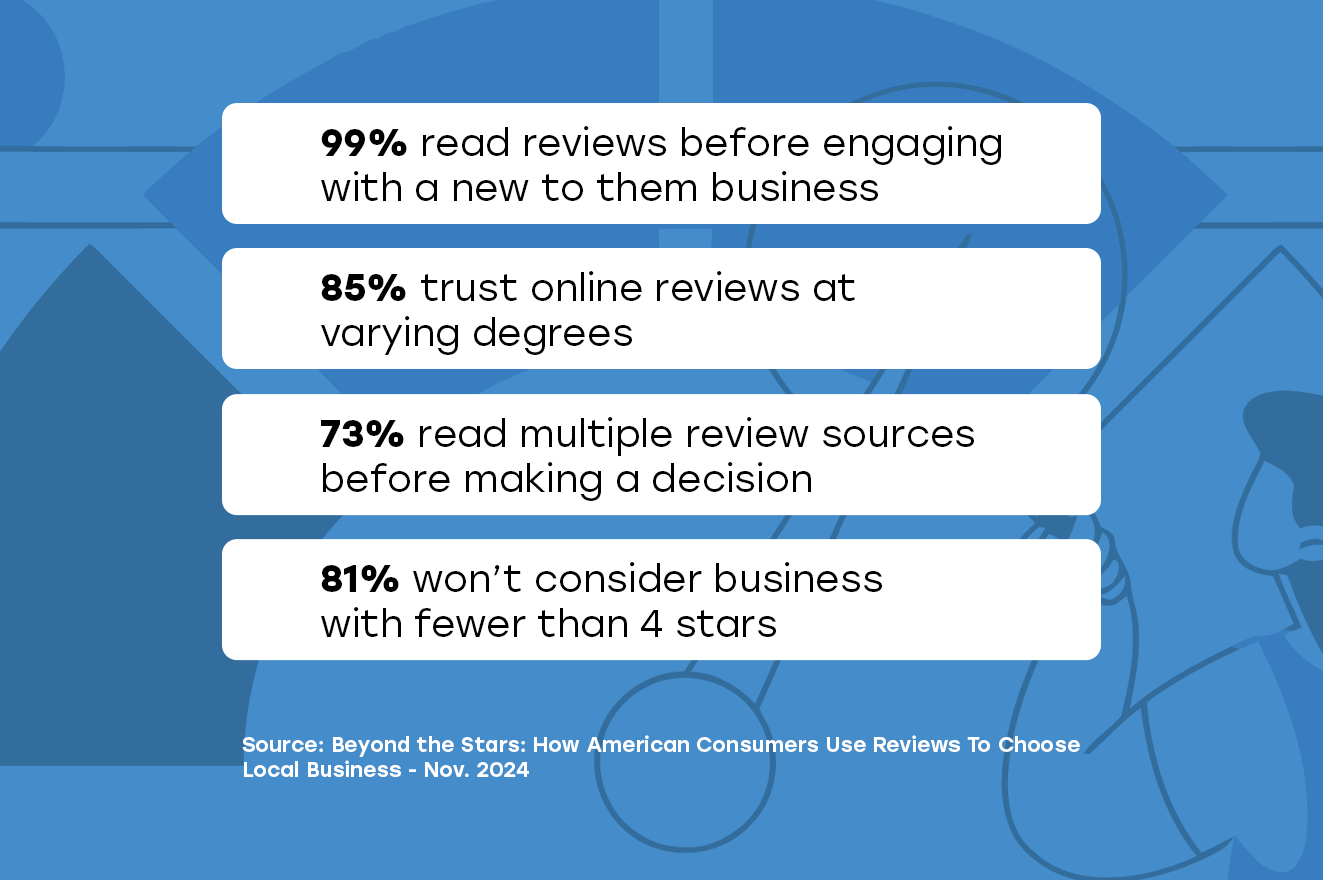
- 99% of consumers read reviews before engaging with a new business
- 85% trust online reviews at varying degrees
- 73% read multiple review sources before making a decision
- 81% won’t consider a business with fewer than 4 stars
Ask More, Receive More: The Ongoing Impact of Proactive Review Generation
The more you ask for reviews, the more you receive. When you make review requests a central part of your reputation management strategy, it can have a measurable impact on a host of factors, including review volume, SEO, public trust, customer sentiment, and star ratings.
With the Consumer Voice Review Widgets, each review collected also strengthens your CRM, helping you connect, upsell, and build long-term customer relationships.
Review Volume Trends (2023 vs. 2024)
Proactively requesting reviews—rather than passively waiting—consistently increases review volume. This remained clear from 2023 to 2024. When businesses in the following industries proactively asked for reviews, these were the average numbers of first-party and third-party reviews they received:
| First and third-party review volume averages by industry in 2023 and 2024 | ||||
| Industry | Avg. 1st Party Reviews (2023) | Avg. 1st Party Reviews (2024) | Avg. 3rd Party Reviews (2023) | Avg. 3rd Party Reviews (2024) |
| Healthcare | 443 | 187 | 66 | 43 |
| Insurance | 49 | 150 | 11 | 32 |
| Restaurants | 327 | 162 | 63 | 137 |
| Legal & Law | 21 | 31 | 29 | 32 |
| Storage & Transportation | 140 | 144 | 94 | 60 |
| Construction | 37 | 39 | 29 | 60 |
In 2024, the Insurance industry saw the largest growth in both first-party and third-party reviews when requests were made — the highest increase across all industries. Restaurants also recorded a strong rise in third-party reviews when they proactively asked customers.
Not all sectors followed this trend. Healthcare experienced sharp declines in both first- and third-party reviews from 2023 to 2024. A key factor is the timing and method of the request: ask at the appointment, then follow up via email or SMS to boost recall and response.
By contrast, waiting too long to request feedback — or relying only on a single channel — often produces weaker results, reducing review volume and recency (two inputs that influence both visibility and trust).
Timing matters: 66% of consumers prefer being asked for a review on the same day as service. Delays or relying only on email reduces both volume and recency, which in turn hurts visibility and trust.
Good to Know
One of the main objectives of review generation is to keep a steady stream of fresh reviews.
The best way to achieve this is through a multichannel approach to review requests.
The Consumer Voice platform provides this approach for local businesses, with six ways to request reviews and feedback — each designed to build credibility, one interaction at a time.
Review Request & Response Best Practices
✅ Do This
Ask in person at the time of service (when feedback is fresh), with your location QR display.
- Follow up within 24 hours by email or SMS.
- Include review links on receipts, signs, or QR codes to make it easy.
- Send reminders via email & SMS to increase response rates.
- Use a friendly, inviting tone.
- Respond to both positive & negative reviews within 24 hours.
- Investigate negative reviews and follow up with a resolution.
🚫 Don’t Do This
- Wait too long to ask — response rates drop quickly.
- Rely only on one channel (e.g., just Google).
- Make the process complicated or hide it behind too many clicks.
- Be inconsistent — occasional requests won’t build steady volume.
- Sound pushy or demanding.
- Fail to reply to reviews. Customers want to know their voices are heard and valued.
- Ignore negative reviews or respond in a defensive tone.
Conclusion
Online reviews remain one of the most powerful tools for building trust and growing locally.
Businesses that prioritize proactive review generation and consistent reputation management gain visibility, customer confidence, and long-term loyalty.
In 2025 and beyond, those who embrace these practices will stand out from the competition.
When you receive a review in person using the Consumer Voice Review Widget, follow up within 24 hours with a thank-you message.
Encourage happy customers to share their reviews on social media with friends and followers.
And you, as a business, can also share your best reviews on Facebook, Instagram, and Google Post — all directly from your Business Dashboard, using the Consumer Voice Social Sharing Widget.
Good to Know – Sources
- Consumer Voice – Review Widgets (product overview).
Retrieved from: https://consumervoice.eu/en/. (consumervoice.eu)
Consumer Voice – Business Dashboard (plans & core features).
Retrieved from: https://consumervoice.eu/en/subscriptions/. (consumervoice.eu)